Manufacturers won't prioritise EPD quality until they can see it
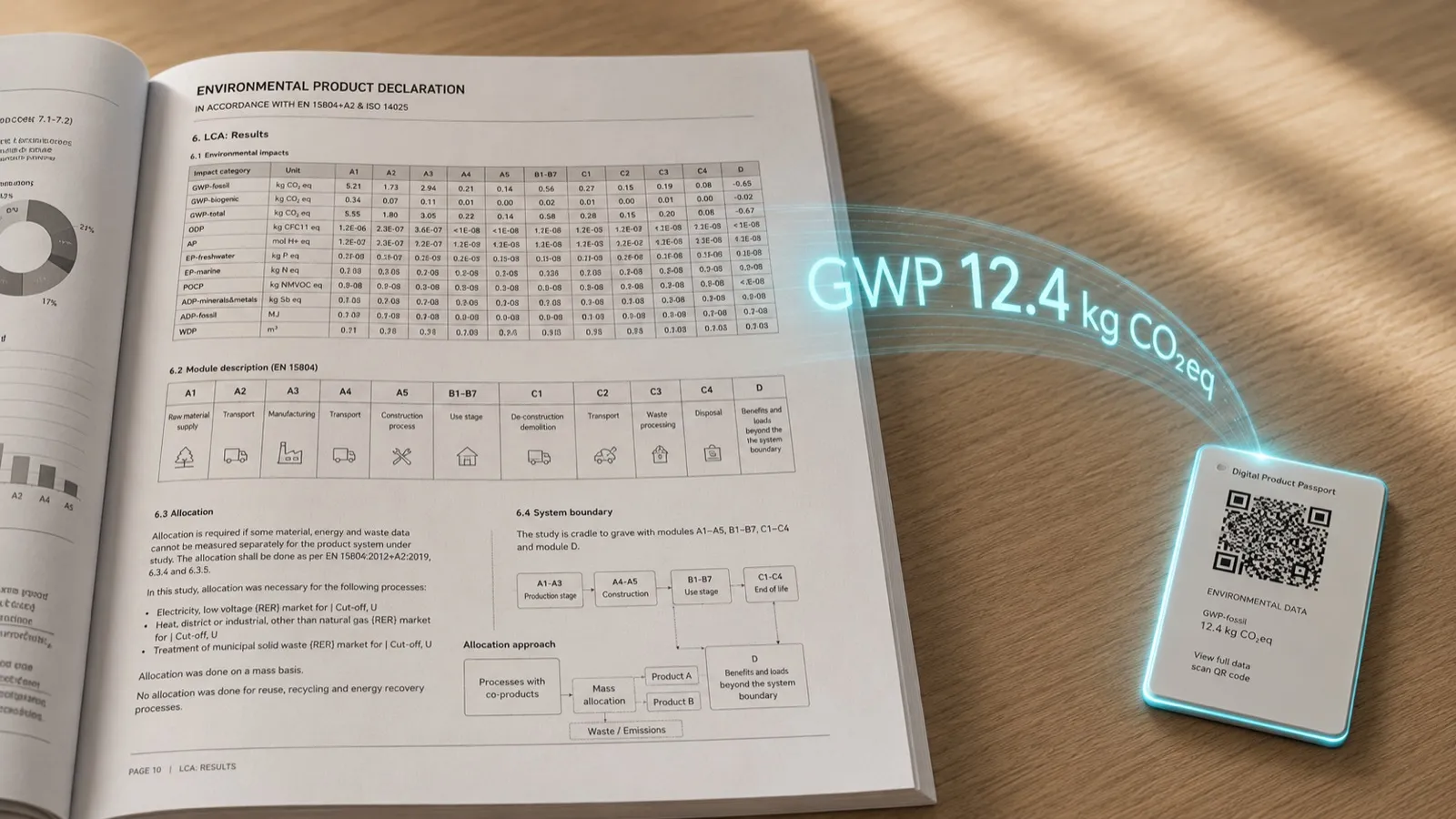
Manufacturers won’t prioritise EPD quality until EPD data is easier to understand and compare for non-specialists.
That is the reality that has become increasingly clear to me while speaking to manufacturers, both big and small, about their Environmental Product Declarations. And it has changed how I think about where the EPD market goes next.
The gulf between EPD specialists and the people driving the market
I am passionate about EPD quality, like so many other EPD developers and verifiers. But there is a huge gulf between us and the people actually driving the EPD market. That includes both the manufacturers ordering EPDs and the specifiers requiring them.
We love getting deep into the weeds. How robust is the underlying modelling? Which datasets were used? How do the allocation choices and assumptions shape the results? These questions matter enormously, because they determine whether an EPD reflects reality or just produces a plausible-looking number.
The market drivers usually want something much simpler. They glance at a single GWP figure and check how it compares with competitors.
That is not a criticism. It is just how the market works today.
Why speed and cost win
For most manufacturers, quality differences between EPDs are still largely invisible. Two declarations for similar products look comparable on the surface, even when one is built on careful, well-documented modelling and the other is not. The numbers sit in the same tables, in the same format, with the same verification stamp.
When quality is invisible, it cannot be a purchasing criterion. So speed and cost take priority. A manufacturer choosing between EPD providers sees one clear difference: one is faster and cheaper. Everything else looks the same.
We need to understand this from their perspective. Manufacturing is highly complex and competitive. Not everyone dealing with EPDs should need to be an EPD specialist. There are already so many other product specifications, certifications, and regulations competing for their attention.
The fact that embodied carbon is now increasingly factored into purchasing decisions is already an important step forward. But right now it mostly has a glancing value. A number gets compared, a box gets ticked, and the depth behind that number rarely enters the decision.
Making EPDs easier does not automatically make them better
There are more and more tools helping more people make EPDs faster. That is useful. But easier production alone does not change the market incentives that shape demand for quality.
If anything, it raises the stakes. When EPDs become cheap and quick to produce, volume grows, and the range of quality in circulation grows with it. The declarations that took real expertise to build sit next to ones that did not, and the market still cannot tell them apart.
The bottleneck is not production capacity. It is quality visibility.
The dynamic that needs to change
To incentivise manufacturers to work with the best EPD developers and verifiers, EPD quality needs to be visible and understandable for everyone. Not just for specialists who can read between the lines of a background report, but for the manufacturers commissioning EPDs and the specifiers relying on them.
When quality becomes visible, the incentives flip. Manufacturers gain a reason to invest in better data and better developers, because the difference finally shows. Specifiers can weigh the reliability of a declaration, not just its headline number. And the developers and verifiers doing careful work stop competing purely on price against those who are not.
That is the most important dynamic to change if we want the whole construction sector to get more value from EPDs.
Why AI shifts this in favour of quality
Something I wrote a year ago, and want to reiterate: the big impact from AI is not just going to come from our own use of it. We all operate in a bigger ecosystem where everyone around us also has access to new and evolving tools.
In the case of EPDs, I think this works strongly in favour of quality EPD developers. As specifiers gain tools that help them factor in and assess EPD quality, quality becomes part of the comparison rather than an invisible attribute. As manufacturers gain tools that help them understand their own EPD results, they start asking better questions of their developers, and they start noticing where the answers differ.
The expertise gap does not disappear. But the visibility gap can shrink dramatically. And once quality is visible, the market can start rewarding it.
What we are building at Lodestellar
This is why I am excited to support quality EPD developers as they scale their work. At Lodestellar, we want to make EPD quality easier to spot, compare, and value.
Not to replace those with the highest expertise. Not to police anyone. But to help shape the market advantage in their favour, by making the quality they already deliver visible to the people making decisions.
Lodestellar is an EPD quality review platform. It helps identify potential quality issues earlier and more systematically: before verification to catch issues sooner, during verification to support more structured review, and after publication to better understand potential risks when using an EPD.
The EPD market will keep growing either way. Whether it grows in a direction that rewards quality depends on whether quality becomes something everyone can see. That is the problem worth working on.
Related reading