What You Cannot See in an EPD
A review of 75 published EPDs, and what it suggests about transparency in environmental product data
Environmental Product Declarations are increasingly used to make decisions. They inform product comparisons, procurement criteria, design choices, and corporate strategy. That role comes with a responsibility: an EPD should help its reader understand what is driving the result, not just present a number.
The good news is that this is not a new demand. The rules and common practices that support this kind of EPD transparency already exist. The open question is whether published EPDs actually follow them.
Four things a reader should be able to see
Electricity assumptions. Two manufacturers can report very different results for similar products simply because of how they model electricity. One may rely on green certificates purchased from a market far from the production site; another may use the actual grid factor where production happens. Both approaches exist in practice, but they are not the same thing, and the reader needs to know which one they are looking at.
Biogenic carbon, handled consistently. If carbon uptake is shown in one life cycle stage, it should be clear what happens to that carbon later. When this is not handled correctly, bio-based packaging can make a product look better on paper. Promoting more packaging was never the sustainability endgame anyone intended.
The drivers behind dominant contributors. When electricity accounts for a large share of the result, say 30 percent or more, the reader should be able to see what is behind it. Process performance, energy sourcing, and modelling choices are very different explanations, and they lead to very different conclusions.
Data quality that means something. Terms like “good” or “very good” only help if they are anchored to a shared reference. EN 15804+A2 provides one, in Tables E.1 and E.2. Without such an anchor, a data quality statement is an opinion, not an assessment.
What 75 published EPDs showed
To see how visible these basics actually are, I reviewed 75 published EPDs. They came from publishers who generally do a good job and who operate within systems designed to support exactly these requirements. If transparency is working anywhere, it should be working here.
The results:
- 39 of 75 did not explain how electricity was modelled.
- 20 did not report their electricity factor (GWP per kWh).
- 10 did not explain what happened to the biogenic carbon in their packaging, or reported figures that did not add up numerically.
- 62 did not describe their background data quality against this kind of shared reference.
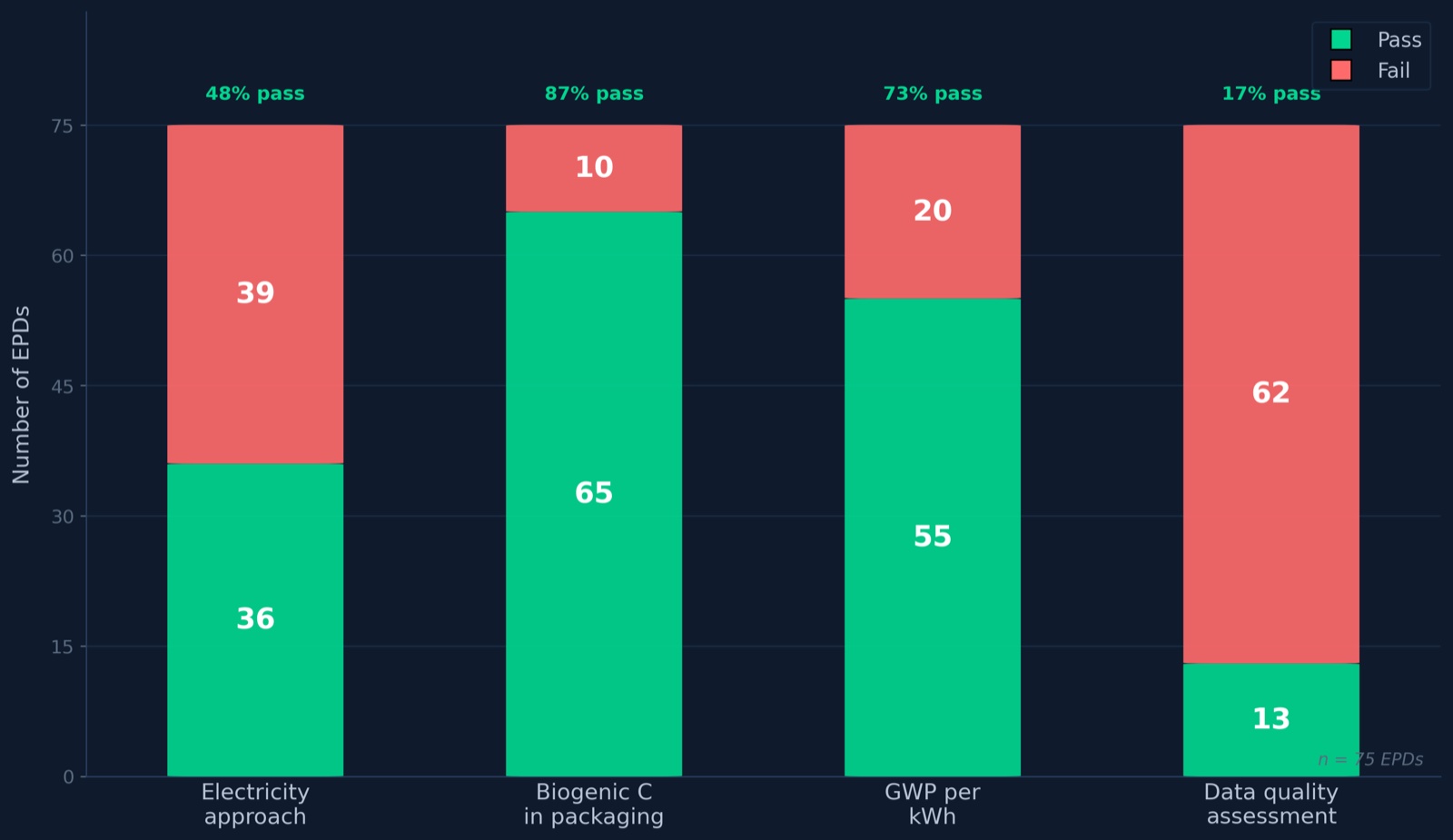
Pass and fail rates across the four transparency checks, n = 75 EPDs.
Visibility, not blame
None of this means the underlying work is wrong. In many cases the logic almost certainly exists in the background report, in the model, or in the practitioner’s head. But an EPD is a communication document. If the user cannot see the reasoning, they cannot evaluate it, and an assumption that cannot be evaluated cannot be trusted, however sound it may be.
This matters because EPDs are no longer static documents filed away after verification. They feed procurement decisions, building-level assessments, and regulatory reporting. When a declaration is silent on how electricity was modelled or where its data quality stands, that silence travels into every decision built on top of it.
Why I keep coming back to this
The EPD quality problem is often framed as a question of what is wrong in a declaration. Just as often, it is a question of what is impossible to see. Those are different problems, and the second one is more tractable than it looks: the requirements exist, the reference tables exist, and the checks are repeatable.
That is exactly why I built Lodestellar: to help spot transparency and quality issues faster, more consistently, and before they affect decisions.
If you work with EPDs, whether developing, verifying, or using them, I would be curious whether these findings match what you see in your own corner of the market — let me know.
Related reading